
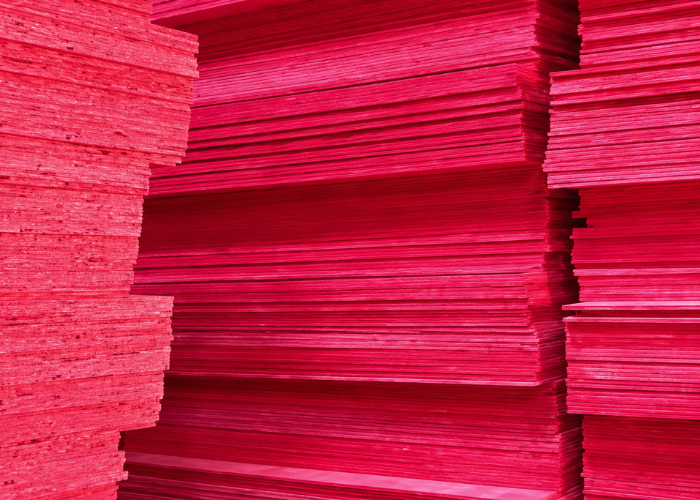
The so-called “pink plywood,” commonly used for construction site fences and other temporary applications in the construction industry, is an interesting example of how the industry combines wood, adhesives, resins, and dyes to produce a material with specific characteristics.
Although it is popularly known for its pink or reddish color, this coloration does not necessarily mean that the wood itself has been dyed throughout. In many resin-coated plywood systems, the color is mainly associated with the coating applied to the surface of the panel.
Among the dyes that can be used to produce intense pink, red, or magenta shades is Rhodamine B, an organic dye belonging to the xanthene dye family.
What Is Pink Plywood?
The plywood used for construction site fences is a wood panel formed by stacking layers of wood veneer, generally obtained from fast-growing species.
The veneers are positioned with their grains running in different directions and bonded together with adhesives. After pressing and forming the panel, a surface coating may be applied to improve certain characteristics of the material.
This coating may provide:
- characteristic coloration;
- surface protection against moisture;
- reduced surface water absorption;
- improved visual appearance;
- commercial identification of the product.
The protection provided by this type of finish, however, should not be confused with permanent waterproofing. Panel performance will depend on the wood, adhesive, coating formulation, applied thickness, and exposure conditions.
Where Does the Pink Color Come From?
One of the main questions regarding pink plywood is whether the wood itself is actually dyed. In a surface coating system, the answer is not necessarily. The panel may receive a film containing a resin or another polymer into which a coloring system has been incorporated. In this way, the color observed on the surface is mainly related to the finish.
This characteristic explains why, when the panel is cut, the interior may retain the natural color of the wood, while the faces remain pink or reddish. Therefore, color can serve a much broader purpose than aesthetics alone: it facilitates visual identification of the product in the construction environment.
Rhodamine B: A High-Intensity Dye
Rhodamine B is an organic dye belonging to the class of xanthene dyes. Its chemical identification includes:
Name: Rhodamine B
CAS: 81-88-9
Color Index: C.I. 45170
Color Index Name: Basic Violet 10
One of the most notable characteristics of this dye is its high tinting strength, associated with an intense reddish-pink/magenta color and characteristic fluorescence. These properties allow relatively small amounts of the dye to produce a significant visual color change. For industrial applications where an intense color is desired with low raw material consumption, this characteristic can be particularly interesting.
Why Does Rhodamine B Have Such High Color Intensity?
The intensity of Rhodamine B is related to its molecular structure and the electronic system responsible for light absorption. Xanthene dyes contain conjugated systems that strongly interact with electromagnetic radiation in the visible region. As a result, even relatively low concentrations can produce visually intense coloration. In addition to its color, Rhodamine B also exhibits fluorescence, a characteristic that contributes to the vivid and bright appearance observed under certain lighting conditions.
Solubility: A Fundamental Factor in Formulation
Choosing the appropriate vehicle is one of the most important steps when using Rhodamine B. Conventional commercial Rhodamine B is an ionic form and has a high affinity for polar media. Therefore, it exhibits good solubility in water and certain alcohols. This behavior has an important practical consequence:
The choice of solvent or vehicle must take into account both the chemical form of the dye and the nature of the resin being used. It is not correct to assume that any organic solvent will dissolve Rhodamine B with the same efficiency. Hydrocarbon solvents, for example, behave very differently from water and alcohols when interacting with an ionic dye. Therefore, formulation must be developed by considering the system as a whole:
dye + solvent/vehicle + resin + additives + substrate.
Rhodamine B in Water-Based Systems
When the coating used on the plywood contains a significant aqueous phase, Rhodamine B can be pre-dissolved in water and subsequently incorporated into the formulation. A typical development procedure may follow this logic:
Rhodamine B → pre-dissolution → concentrated solution → incorporation into the vehicle → homogenization → application.
Pre-dissolution offers an important advantage: it reduces the risk of particle formation or areas with excessive dye concentration during preparation. The solution should be incorporated under adequate agitation, allowing the dye to be uniformly distributed throughout the system.
What About Alkyd Resin?
The situation becomes more complex when working with a conventional alkyd resin, particularly in predominantly organic systems. Alkyd resins contain regions with different polarity characteristics and can be formulated with various solvents and modifiers. Therefore, compatibility with an ionic dye such as Rhodamine B should not be assumed solely based on the presence of polar groups in the resin structure. In these cases, formulation strategies that may be evaluated include:
- pre-dissolution of the dye;
- use of co-solvents;
- modified alkyd systems;
- water-based emulsions or dispersions;
- use of a chemical form of the dye that is more compatible with organic systems.
The appropriate approach should be determined experimentally for each formulation.
Rhodamine B and Rhodamine B Base Are Not the Same
An important point for professionals working with the formulation of paints, coatings, and dyes is the distinction between conventional Rhodamine B and Rhodamine B Base. Conventional Rhodamine B is commercially available in an ionic form, whereas Rhodamine B Base has a different structure and solubility behavior. Rhodamine B Base is associated with C.I. Solvent Red 49. This difference is important because the chemical form of the dye directly influences its compatibility with:
- water;
- alcohols;
- organic solvents;
- resins;
- polymers;
- coating systems.
Therefore, when specifying a dye for an industrial application, it is not enough to simply state “Rhodamine.” It is necessary to correctly identify which chemical product is being used.
How Much Rhodamine B Is Required?
There is no universal concentration of Rhodamine B that can be applied indiscriminately to all coating systems for plywood. The required amount depends on several factors:
- dye concentration and purity;
- resin type;
- solids content;
- solvent used;
- application method;
- film thickness;
- substrate absorption;
- desired shade;
- presence of other dyes or pigments;
- drying conditions.
For this reason, a safer and technically appropriate approach is to establish the concentration through development trials. A laboratory may, for example, prepare different concentrations and evaluate color intensity both visually and instrumentally. The objective is to determine the lowest concentration capable of achieving the specified shade while maintaining adequate stability and performance.
How to Develop a Formulation for Pink Plywood
A development process can follow four main stages.
1. Dye Preparation
Rhodamine B is first dissolved in a compatible vehicle. The concentration of the stock solution should be known and controlled.
2. Incorporation into the Resin
The concentrated solution is gradually added to the coating system under agitation. This step should ensure uniform distribution of the dye.
3. Application to the Wood
The coating can be applied using different industrial methods, depending on the production process:
- roller;
- spray;
- curtain coating;
- immersion;
- other application systems.
The objective is to achieve uniform coverage of the specified surfaces.
4. Drying or Curing
After application, the panel must undergo the appropriate drying or curing process for the type of coating used. This stage directly influences the final appearance and performance of the film.
Dye Is Not a Waterproofing Agent
It is important to distinguish between two functions that are often confused. The dye primarily provides coloration. The resin or coating determines a significant portion of the surface protection. Therefore, increasing the concentration of Rhodamine B does not necessarily increase the panel’s resistance to water. Moisture performance depends mainly on characteristics such as:
- polymer type;
- resin composition;
- solids content;
- coating thickness;
- adhesion;
- degree of curing;
- additive formulation.
This distinction is essential for developing a technically consistent product.
How to Control Color Quality
For industrial production, it is not enough to simply evaluate whether the panel “is pink.”A more comprehensive quality control program may consider:
Color
Evaluation of shade and uniformity between batches.
Intensity
Verification of the concentration required to achieve the specified standard.
Uniformity
Analysis of dye distribution across the surface.
Adhesion
Verification of coating adhesion to the substrate.
Water Resistance
Evaluation of film changes and dye migration after contact with water.
Abrasion Resistance
Important for materials that will be handled during transportation and assembly.
Stability
Evaluation of the formulation during storage and after exposure to light and temperature.
The Importance of Choosing the Right Dye
Developing a pink coating for plywood does not simply consist of adding a red dye to the resin. It is necessary to consider the compatibility chemistry between all components of the formulation. A suitable system should provide:
good solubility + good compatibility + stability + color intensity + uniformity + adhesion + film performance.
Therefore, dye selection should be carried out together with the selection of the resin and application process.
Conclusion
The pink coloration of plywood used for construction site fences is an example of an industrial application in which dye chemistry, coating technology, and wood processing work together. Rhodamine B, identified as C.I. 45170 / Basic Violet 10, has characteristics that can be interesting for obtaining intense pinkish-red shades, particularly when used in systems compatible with its chemical nature. However, its performance does not depend solely on dye concentration. The choice of vehicle, resin, application method, and drying conditions is essential for achieving a uniform and stable surface. For industrial applications, the best practice is to develop the formulation through controlled testing, establishing the minimum concentration required to achieve the desired color standard without compromising the properties of the coating. In other words, the secret behind “pink plywood” lies not only in the dye: it lies in the complete coating formulation.