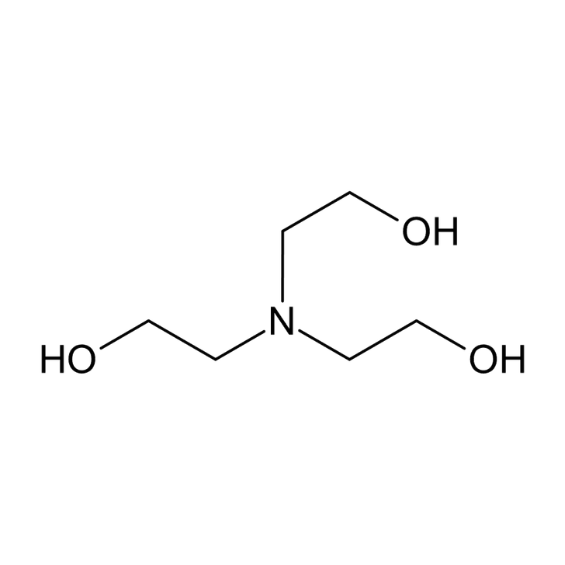
Triethanolamine 99% is a weak base classified as an amino alcohol. It appears as a clear, colorless liquid with an ammoniacal odor. It is a hygroscopic product, soluble in water, ethyl alcohol, and chloroform, and insoluble in benzene, ether, and petroleum distillates. It is obtained through the reaction of ethylene oxide with diethanolamine.
As an amino alcohol, Triethanolamine 99% can participate in chemical reactions involving both amine and alcohol groups. In the presence of acids, it acts as a mildly basic amine, forming salts or soaps. As an alcohol, Triethanolamine 99% is hygroscopic and can undergo esterification.
In the cosmetics industry, Triethanolamine 99% is used as an emulsifier, cleansing agent, buffering agent, humectant, and alkalizing agent in various formulations. It is used in hair care products such as shampoos, conditioners, sprays, and styling gels, where it acts as a humectant and alkalizing agent. In makeup products, it is mainly used in eyeshadows and eyeliners and can also be used in facial products such as masks, cleansing lotions, and eye creams. (CAS: 102-71-6)
Triethanolamine 99% is a weak base classified as an amino alcohol. It appears as a clear, colorless liquid with an ammoniacal odor. It is a hygroscopic product, soluble in water, ethyl alcohol, and chloroform, and insoluble in benzene, ether, and petroleum distillates. It is obtained through the reaction of ethylene oxide with diethanolamine.
As an amino alcohol, Triethanolamine 99% can participate in chemical reactions involving both amine and alcohol groups. In the presence of acids, it acts as a mildly basic amine, forming salts or soaps. As an alcohol, Triethanolamine 99% is hygroscopic and can undergo esterification.
In the cosmetics industry, Triethanolamine 99% is used as an emulsifier, cleansing agent, buffering agent, humectant, and alkalizing agent in various formulations. It is used in hair care products such as shampoos, conditioners, sprays, and styling gels, where it acts as a humectant and alkalizing agent. In makeup products, it is mainly used in eyeshadows and eyeliners and can also be used in facial products such as masks, cleansing lotions, and eye creams. (CAS: 102-71-6)