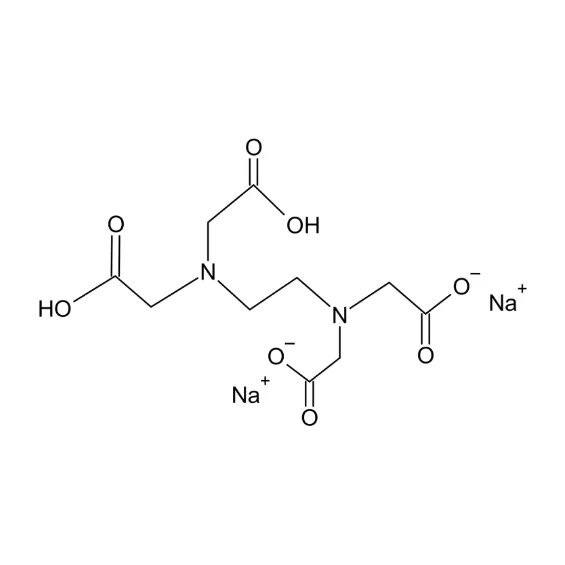
Disodium EDTA Dihydrate is an organic salt derived from ethylenediaminetetraacetic acid, classified as a chelating agent. It appears as a white, virtually odorless powder that is highly soluble in water and insoluble in common organic solvents. It is slightly acidic and remains stable under normal temperature and humidity conditions. It is a non-volatile and slightly hygroscopic compound with a strong affinity for divalent and trivalent metal ions, such as calcium, magnesium, iron, and copper. It forms stable complexes in aqueous media, especially at slightly acidic to neutral pH levels. Disodium EDTA Dihydrate has a pH closer to neutrality when dissolved in water (typically between 4.3 and 4.7 in a 1% solution), making it more suitable for formulations sensitive to pH variations, especially compared to Tetrasodium EDTA, whose solution is strongly alkaline. In addition, it tends to have a lower impact on the system’s final alkalinity, thereby preserving the integrity of components that are more unstable at high pH levels. It is a chemically stable product, even when exposed to light and moderate heat. Disodium EDTA Dihydrate is widely used as a chelating agent in various formulations. Its main function is to sequester divalent and trivalent metal ions, such as calcium, magnesium, iron, and copper, thereby preventing unwanted reactions that these metals might catalyze. This ability to form metal complexes directly contributes to the chemical stability of liquid products, emulsions, and aqueous solutions. (CAS: 6381-92-6)